20 Best Things to Do in Budapest (2026 Local Travel Guide)
Last Updated: July 2026, Written by Adam, a Budapest local who’s spent years exploring the city’s attractions.
Looking for the best things to do in Budapest? This guide covers the city’s top attractions, Danube river cruises, thermal baths, local food, nightlife, and hidden gems to help you plan the perfect 2–4 day itinerary.
Budapest doesn’t give up its best side in a single afternoon, and that’s exactly what makes it worth the trip. I live here, and even after years of walking these streets, the city still finds a way to surprise me.
📋 What’s In This Guide
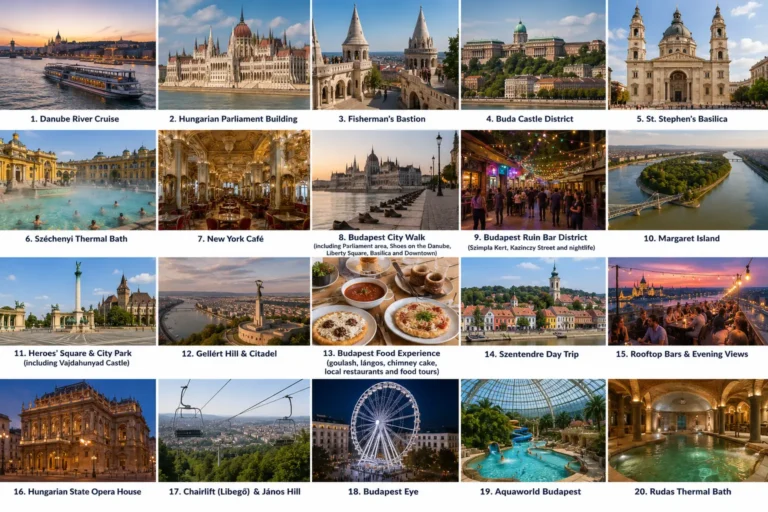
- Danube River Cruise
- Hungarian Parliament Building
- Fisherman’s Bastion
- Buda Castle District
- St. Stephen’s Basilica
- Széchenyi Thermal Bath
- New York Café
- Budapest City Walk
- Ruin Bar District
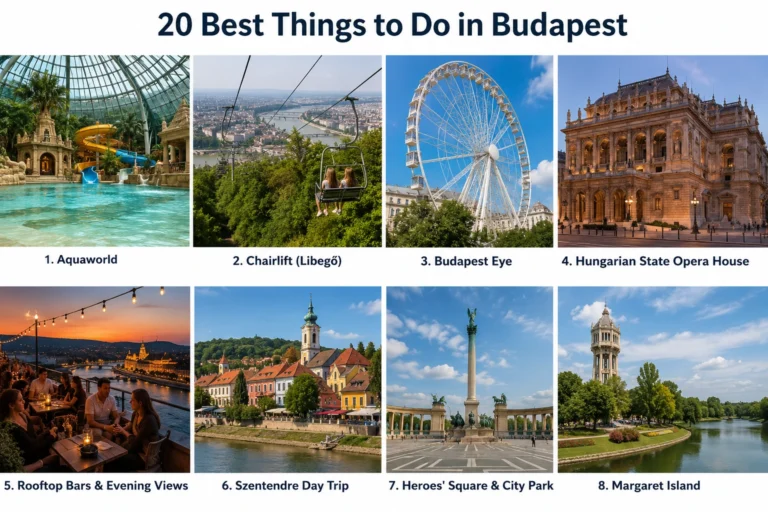
- Margaret Island
- Heroes’ Square & City Park
- Gellért Hill & Citadel
- Budapest Food Experience
- Szentendre Day Trip
- Rooftop Bars & Evening Views
- Hungarian State Opera House
- Chairlift (Libegő) & János Hill
- Budapest Eye
- Aquaworld Budapest
- Rudas Thermal Bath
- 3-Day Budapest Itinerary
- More Things to Do in Budapest
- Frequently Asked Questions

1. Danube River Cruise
If you only do one thing from this entire list, make it this. Budapest is genuinely one of the few capitals where the view from the water beats the view from the ground — Parliament, Buda Castle, and Chain Bridge are all built to be seen from the Danube, lit up gold against the dark water at night.
Who it’s for: everyone, honestly. Even travelers who normally skip „touristy” boat trips tend to admit this one earns its reputation.
How much time: most sightseeing cruises run 60–75 minutes; dinner cruises run closer to 2–3 hours.
A basic daytime cruise is fine, but the real magic happens after sunset, once the buildings are floodlit. For a first Budapest evening, a Night Sightseeing Cruise hits the sweet spot of price and experience. If you want the evening to feel more like an occasion, an Unlimited Prosecco Cruise adds a livelier, social atmosphere without the higher price tag of a full dinner. For anniversaries or a proper date night, the Candlelit Dinner Cruise with Live Music is the one to book — reserve it at least a few days ahead in peak summer, since the good time slots sell out.
Insider tip: book the slot closest to sunset, not the latest one. You get the golden-hour light on the way out and the full light show on the way back.
A few practical notes that don’t make it into most guides: most cruise boats have both an open-air upper deck and a covered lower deck, so weather rarely cancels anything — you just shift decks. In July and August, book at least 2–3 days ahead; outside peak summer, next-day booking is usually fine. And if you’re traveling with kids, the shorter sightseeing cruise is a better fit than the dinner cruise, which runs long for younger attention spans.
Want the full breakdown of every cruise option, prices, and which one actually suits your trip? Our Best Budapest River Cruises guide compares all of them side by side, and if you’re deciding between a party atmosphere or a romantic one, check our Best Budapest Night Cruises and Best Budapest Dinner Cruises guides next.
2. Hungarian Parliament Building
Hungary’s Parliament is the largest building in the country, and for most first-time visitors, the single image they associate with Budapest before they even arrive. It sits directly on the Danube, which is precisely why the river cruise above is worth doing — you get to see it from the angle it was designed for.
Who it’s for: first-timers, architecture fans, photographers.
How much time: 30 minutes for exterior photos, 45–60 minutes if you book the interior tour.
The interior — a Gothic Revival staircase, the Hungarian Crown Jewels, gold-leafed halls — is worth booking ahead. This is the most common mistake tourists make here: showing up without a ticket, assuming they can buy one at the door, and finding the day’s slots sold out. Book online at least a few days ahead in summer.
Photo tip: the best exterior shots come from the Buda-side embankment near Batthyány tér, especially just after sunset when the building is lit but the sky still has some color.
Practical tip: treat the visit like an airport security line — bags are screened, and you’ll need to arrive with your passport, since it’s checked against your ticket. Budget 15–20 minutes before your slot for this, and don’t book it back-to-back with something else across town.
3. Fisherman's Bastion
Seven fairy-tale white towers, one for each of the Magyar tribes that settled the Carpathian Basin, sitting on a terrace above the Danube. It photographs better than almost anywhere else in the city, which is exactly the problem — tour groups know it too.
Who it’s for: photographers, first-time visitors, anyone doing the Castle District in one visit.
How much time: 30–45 minutes.
The lower terrace is free and open all day. The upper towers charge a small entry fee for a slightly higher vantage point — honestly, the free view is close enough that most people can skip paying unless you want the postcard-perfect shot without a railing in it.
Best time to visit: arrive at sunrise. By 10 a.m. this terrace is shoulder-to-shoulder with tour groups; by 7 a.m. you might have it nearly to yourself. It’s directly next to Matthias Church, so pair the two.
Evening tip: it’s worth a second visit after dark. The towers are floodlit, most of the day-trip crowds are gone, and the view down toward the illuminated Parliament across the river is arguably better than the daytime version.
4. Buda Castle District & Budavári Sikló
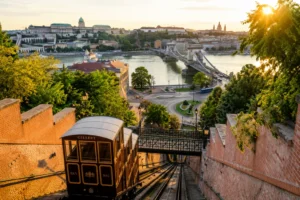
This whole hilltop neighborhood was the seat of Hungarian royalty for centuries, and it still feels separated from the rest of the city — cobblestones, narrow lanes, and a palace complex that now houses the Hungarian National Gallery and the Budapest History Museum.
Who it’s for: history and art lovers get the most out of the museums; everyone else can enjoy it as a walk.
How much time: an hour for the walk and views, half a day if you’re doing the museums properly.
Take the funicular (Budavári Sikló) up from Clark Ádám tér for the experience, but don’t feel obligated — it’s a short, pleasant walk up if you’d rather save the money and skip the line.
Common mistake: trying to „do” the whole Castle District and both museums in under an hour. Pick one museum if you’re short on time, and treat the district itself as a slow wander rather than a checklist.
Also worth knowing: the Buda Castle Labyrinth, a network of caves and cellars beneath the hill, is a good rainy-day alternative if you’ve already done a bath that day and want something different in the same neighborhood.
 4.9/5
4.9/5
Price: From €14
Best for: First-time visitors, history lovers & panoramic city views
Duration: 2 hours
Meeting point: Buda Castle District
Budapest: Buda Castle – Historical walking tour with a royal cake
Explore the charming streets of Budapest’s UNESCO-listed Buda Castle District with a knowledgeable local guide. Discover centuries of Hungarian history while visiting famous landmarks, hidden courtyards and spectacular viewpoints overlooking the Danube and Parliament.
Buda Castle Hill Tour: Fisherman’s Bastion & Matthias Church
Discover two of Budapest’s most famous landmarks on a guided walk through the historic Castle Hill. Enjoy breathtaking views from Fisherman’s Bastion, admire the stunning Gothic architecture of Matthias Church, and learn the fascinating stories behind Hungary’s royal past.

4.9/5
Price: From €22
Best for: Iconic viewpoints, photography & history lovers
Duration: 2 hours
Meeting point: Fisherman’s Bastion
5. St. Stephen's Basilica
Budapest’s largest church, and one of only two buildings in the city legally allowed to be as tall as it is (the other is Parliament — a deliberate rule symbolizing the balance of worldly and spiritual power). Inside, it holds the mummified right hand of Hungary’s founding king, which is a stranger and more memorable stop than it sounds.
Who it’s for: almost everyone passing through downtown Pest — it’s centrally located and quick to fit in. If you like a Historical good buildings.
How much time: 20 minutes for the interior, add 20–30 more if you climb the dome.
Photo tip: the dome climb (elevator most of the way, stairs for the last stretch) gives you one of the best 360-degree views in the city, arguably better value than some paid observation decks nearby.
Practical tip: dress code is enforced — cover shoulders and knees. Check ahead for free evening organ concerts, which happen periodically and aren’t well advertised outside Hungary.
Compared to other viewpoints: if you’re deciding between the dome climb here, Gellért Hill, or the MOL Campus SkyDeck, the Basilica dome wins on location — you’re standing right above the city center, close enough to pick out Parliament and the river in one frame.
6. Széchenyi Thermal Bath
The largest medicinal bath complex in Europe, and the one photo everyone recognizes even if they don’t know the name: steam rising off a bright yellow neo-baroque building, with people playing chess waist-deep in the outdoor pool. It’s not a gimmick — it’s genuinely how locals use it.
Who it’s for: everyone, but especially anyone who wants „the” Budapest bath experience rather than a quieter local alternative.
How much time: 2–3 hours minimum to make it worthwhile.
Best time to visit: early morning (opening time) or evening. Midday is when tour buses arrive and the outdoor pools get genuinely crowded.
Common mistake: not bringing your own towel, flip-flops, or padlock. You can rent everything on-site, but it costs more and takes time out of your visit — pack light gear yourself if you can.
How it works: you’ll get either a cabin or a locker depending on your ticket type — cabins cost more but give you a private space to change, while lockers are cheaper and perfectly fine if you don’t mind changing in a shared area. The indoor thermal pools and sauna complex are worth at least 30 minutes beyond the outdoor pools most photos focus on.
7. New York Café Budapest
An ornate, gold-and-marble 19th-century café inside what’s now the New York Palace hotel — regularly (if a little dramatically) called one of the most beautiful cafés in the world. It’s touristy, it’s overpriced for what’s in the cup, and it’s still worth doing once.
Who it’s for: a one-time splurge, not a daily coffee stop.
How much time: 45–60 minutes.
Insider tip: either book a table in advance or show up right at opening. By mid-morning the line stretches out the door, and walk-ins can wait 30+ minutes just to be seated.
8. Budapest City Walk
Rather than treating downtown Pest as separate attractions, string them together as one unhurried walk: start near Parliament, pass the Shoes on the Danube memorial — a quiet, sobering tribute to Jewish victims shot into the river during WWII, worth a genuinely respectful few minutes rather than a quick photo — continue to Liberty Square, then to St. Stephen’s Basilica, and finish on Váci utca, the main pedestrian shopping street downtown.
Who it’s for: anyone who prefers wandering to a rigid itinerary — this is a great low-effort first afternoon after landing.
How much time: 2–3 hours at an easy pace, longer with café stops, and with shopping.
Practical tip: Váci utca is convenient but priced for tourists. Duck one or two streets over for meals at local prices.
You can join a tourist group at a good price, but you can also plan a city walk independently on your own.
9. Ruin Bar District

Ruin Bar District & Szimpla Kert
Szimpla Kert put Budapest’s ruin bar scene on the map — a crumbling old building in the Jewish Quarter filled with mismatched furniture, plants, and repurposed junk that somehow works as decor. Kazinczy utca, the street it sits on, has since filled up with similar bars, making it an easy area to bar-hop for an evening.
Who it’s for: nightlife-curious travelers of any age, not just the stag-party crowd it sometimes attracts.
How much time: a full evening if you’re bar-hopping, 1–2 hours for just Szimpla.
Yes, it’s touristy now, and yes, locals will tell you it’s not what it was ten years ago. It’s still worth an evening.
Best time to visit: weeknights, especially Thursday, when the mix leans more local and less stag-do. Things don’t really get going until 9–10 p.m.
Practical tip: keep an eye on your drink and belongings — it’s crowded, not dangerous, but pickpocketing opportunists do work busy bar districts.
Beyond Szimpla, Instant and Fogasház (now connected as one sprawling multi-room venue) are worth adding to the night if Szimpla feels too packed to enjoy. If you’d rather not plan your own route, a guided ruin bar pub crawl takes the decision-making out of it and is a good way to meet other travelers.
10. Margaret Island
A car-free island in the middle of the Danube, and the closest thing Budapest has to a collective backyard. Locals come here to run, cycle, and do nothing in particular — which is exactly the point after a couple of days of sightseeing.
Who it’s for: anyone who needs a slower-paced day between heavier sightseeing days.
How much time: half a day, more if you rent a bike or a bringóhintó (a pedal-powered cart, popular with families).
Highlights include the musical fountain (choreographed shows on the hour during the season), a small Japanese garden, and a running track that circles the whole island — about 5.3 km if you want the exercise.
Insider tip: treat this as a „recharge” day rather than a checklist. It’s not a must-see landmark; it’s a break, and it’s a good one.
The island also has its own thermal hotel with a spa open to day visitors, if you’d rather combine the relaxed pace with another bath experience instead of doing Széchenyi or Rudas on a separate day.
11. Heroes' Square & City Park
Heroes’ Square is Budapest’s grandest civic space — the Millennium Monument, flanked by the Museum of Fine Arts on one side and the Műcsarnok exhibition hall on the other. Walk straight through into City Park and you’ll hit Vajdahunyad Castle, a deliberately fantastical building that mashes together Romanesque, Gothic, and Baroque styles into something that looks like it was built for a fairy tale, not a history book.
Who it’s for: pairs naturally with Széchenyi Bath, since they’re a two-minute walk apart.
How much time: an hour for the square and castle, longer if the zoo or circus in City Park interests you.
Practical tip: this is one of the easiest combination days in the city — Heroes’ Square in the morning, City Park, then straight into Széchenyi Bath for the afternoon.
12. Gellért Hill & Citadel
The best panoramic view of Budapest as a whole city — Danube, both banks, every major landmark — comes from here, not from any single building’s rooftop.
Who it’s for: anyone reasonably fit; it’s a moderate uphill walk, not a hike requiring gear.
How much time: 1.5–2 hours round trip, including time at the top.
The Liberty Statue crowns the hill, visible from much of the city below. Partway up, the small Cave Church built into the hillside is worth ducking into if it’s open.
Best time to visit: sunset, without question. Give yourself 30 minutes of buffer to get up there before the light starts dropping — it’s a steeper climb than it looks from below.
Route tip: there are a few paths up; the one starting near Gellért Bath is more shaded and gradual, while the stairs from Szabadság híd (Liberty Bridge) are steeper but faster if you’re pressed for time before sunset.
13. Budapest Food Experience
Quick correction that saves confusion for a lot of visitors: goulash (gulyás) in Hungary is a soup, not the thick stew served under that name abroad. If a menu shows a thick brown stew called „gulyás,” that’s usually pörkölt wearing the tourist-friendly name.
Who it’s for: everyone — this isn’t optional, it’s part of the trip.
How much time: spread across your visit rather than one sitting.
Beyond goulash, try lángos (fried dough topped with sour cream and cheese — the definitive Budapest street food) and kürtőskalács (chimney cake), though the Castle District versions are priced for tourists; you’ll pay less a few streets away. The Great Market Hall near Liberty Bridge is worth an hour — fresh produce and paprika on the ground floor, souvenirs and food stalls upstairs.
Insider tip: if you want structure rather than guessing where to eat, a guided food tour on your first evening pays for itself by pointing you toward better places for the rest of the trip.
Where locals actually eat: look a couple of streets off the main tourist drags in the Jewish Quarter and around Ráday utca — the same quality of food at noticeably lower prices than the restaurants directly on Andrássy Avenue or Váci utca.
14. Szentendre Day Trip
A small, artsy riverside town about 40 minutes north of Budapest, with cobblestone lanes, colorful Baroque houses, and a concentration of small museums and galleries that punches well above its size.
Who it’s for: a good half-day escape if Budapest’s pace starts to feel heavy, especially for travelers staying 4+ days.
How much time: half a day is genuinely enough; you don’t need a full day here.
Getting there is easy and cheap via the HÉV suburban train from Batthyány tér, or by river boat in summer if you’d rather arrive by water.
Practical tip: go on a weekday if you can. Weekends bring day-trippers from Budapest itself, and the narrow lanes fill up fast.
15. Rooftop Bars & Evening Views
Budapest’s skyline is low-rise and historic, which makes its rooftop bars unusually good — you get views of the Basilica or Parliament rather than a generic city skyline.
Who it’s for: evening drinks with a view, best saved for one night rather than every night given the price step-up from ground-level bars.
How much time: 1–2 hours.
360 Bar near Andrássy Avenue and High Note SkyBar at the Aria Hotel (with a direct Basilica view) are the two most reliably good options.
Insider tip: book ahead for sunset time slots in summer — both fill up, and walk-ins often get turned away or seated somewhere with a worse view. Smart-casual dress is expected at both.
16. Hungarian State Opera House
A neo-Renaissance building that rivals Vienna’s opera house in detail, at a fraction of the ticket price — genuinely one of Budapest’s best-value cultural experiences.
Who it’s for: anyone even mildly curious about opera or ballet; you don’t need to be an enthusiast to enjoy an evening here.
How much time: a full performance runs 2–3 hours; a guided daytime tour is closer to 45 minutes.
Practical tip: if a performance doesn’t fit your schedule, the daytime interior tour still gets you into the gold-and-velvet auditorium. Dress code for shows is more relaxed than most visitors expect — smart-casual is fine.
17. Chairlift (Libegő) & János Hill
A genuinely scenic chairlift ride up through the Buda Hills to János Hill, the highest point in Budapest, capped by the Elizabeth Lookout Tower at the summit.
Who it’s for: travelers who want a nature break from the city center without leaving city limits.
How much time: half a day if you combine it with a hike or the Children’s Railway.
Insider tip: ride the chairlift up, then walk down through Normafa, one of Budapest’s most popular hillside recreation areas, or connect with the Children’s Railway for a different way back down. Dress for wind — it’s noticeably cooler and breezier up top than in the city center.
18. Budapest Eye
A 65-meter Ferris wheel on Erzsébet Square, right in the downtown core, with 10-minute rides that give you a quick elevated look at the Basilica, Chain Bridge, and city skyline.
Who it’s for: a quick, easy add-on if you’re already in the square — not a dedicated trip.
How much time: 15–20 minutes including the queue.
Honest take: it’s a nice quick photo op, not a dramatic must-do. Manage your expectations — it’s not the tallest or most spectacular wheel in Europe, and it’s easy to combine with a walk through the ruin bar district since they’re a few minutes apart.
19. Aquaworld Budapest
An indoor water park near the airport, entirely separate in character from the historic thermal baths — this is slides and wave pools, not marble and steam.
Who it’s for: families with kids, or anyone looking for a rainy-day plan that isn’t another museum.
How much time: half a day.
Practical tip: it’s outside the downtown core, so budget time and a taxi or transfer to get there and back — it’s not a walkable or last-minute add-on the way most of this list is.
20. Rudas Thermal Bath
Where Széchenyi is grand and photogenic, Rudas is atmospheric and local — an Ottoman-era octagonal pool sits under a centuries-old domed ceiling, with shafts of light coming through star-shaped holes in the stone.
Who it’s for: travelers who want the authentic bath experience without the tour-group scale of Széchenyi.
How much time: 2 hours minimum.
The rooftop hot tub, added in a modern renovation, has one of the best panoramic Danube views of any bath in the city — worth the visit on its own.
Practical tip: Rudas has historically run single-sex days on parts of its schedule alongside mixed hours; this changes periodically, so check the current schedule before you go rather than assuming.
3-Day Budapest Itinerary
If this is your first visit, here’s how to sequence everything above without doubling back across the city.
Day 1 — Pest Essentials Morning: Parliament Building (book the interior tour ahead), then the Budapest City Walk down to Liberty Square and the Basilica. Afternoon: dome climb at St. Stephen’s, then free time on Váci utca. Evening: Danube River Cruise at sunset — the ideal way to close out day one and get your bearings on the whole city from the water.
Day 2 — Buda Side Morning: funicular or walk up to the Buda Castle District, then Fisherman’s Bastion and Matthias Church. Afternoon: walk or taxi to Gellért Hill for the panoramic view, timed for late afternoon light. Evening: Rudas Thermal Bath to unwind, followed by dinner in the Castle District or back in Pest.
Day 3 — City Park or Day Trip Option A (city-focused): Heroes’ Square and City Park in the morning, straight into Széchenyi Thermal Bath for the afternoon, then an evening in the Ruin Bar District. Option B (day trip): Szentendre in the morning and early afternoon, back in Budapest by early evening for dinner and, if you have the energy, one more night out.
If you have a 4th day, this is where Margaret Island, the Opera House, a rooftop bar evening, or the Libegő chairlift fit in nicely without feeling rushed.
More Things to Do in Budapest
A few extra stops worth knowing about, even if they don’t need a full section:
- Nyugati Railway Station McDonald’s — yes, a fast food restaurant made this list. It occupies a genuinely ornate 19th-century former restaurant space and is worth a two-minute detour if you’re near the station.
- Gül Baba’s Tomb — an Ottoman-era pilgrimage site tucked into the Rózsadomb hillside, small and quiet, with a lovely little garden.
- Liberty Square — grand civic square with a mix of monuments, some genuinely contested politically — worth passing through on the City Walk above.
- Children’s Railway — a narrow-gauge railway through the Buda Hills, staffed largely by children under adult supervision; pairs naturally with the Libegő chairlift.
- Normafa — the go-to hillside spot for locals, hiking in summer, sledding in winter.
- Elizabeth Lookout — Budapest’s highest point, covered above alongside the Libegő chairlift.
- MOL Campus SkyDeck — a 120-meter observation deck atop Hungary’s tallest building, with an AR app pointing out landmarks; book tickets online in advance, as time slots are limited and it’s closed one Monday a month.
- Pinball Museum — a hands-on collection of vintage and modern pinball machines you actually get to play, tucked in the Jewish Quarter.
- Palatinus Beach — an outdoor pool and beach complex on Margaret Island, popular with locals in summer.
- Kopaszi-gát (Kopaszi Dam) — a modern riverside park on the Buda bank, less touristy, good for a quiet sunset with a drink from one of the waterfront bars.
Frequently Asked Questions
Is Budapest worth visiting?
Yes — Budapest combines grand architecture, thermal baths found almost nowhere else in Europe at this scale, an affordable food and nightlife scene, and a genuinely walkable historic center split by the Danube into Buda and Pest.
How many days should I spend in Budapest?
Three days covers the essentials comfortably. Two days works if you’re efficient and skip a day trip. Four or more days lets you add Margaret Island, a rooftop evening, or Szentendre without rushing.
What should I not miss in Budapest?
A sunset Danube river cruise, the Fisherman’s Bastion and Buda Castle District, and at least one thermal bath (Széchenyi or Rudas). These three cover the views, the history, and the experience locals actually do themselves.
Is Budapest expensive?
Budapest is noticeably cheaper than Vienna, Paris, or London for food, drinks, and many attractions, though tourist-zone prices (Castle District, Váci utca) run higher than a few streets away.
What is the best river cruise in Budapest?
For most first-time visitors, a sunset or night sightseeing cruise offers the best balance of price and experience. For a livelier evening, a prosecco cruise adds atmosphere; for a special occasion, a candlelit dinner cruise is the better choice.
Which thermal bath is better, Széchenyi or Rudas?
Széchenyi is bigger, grander, and more social, with the famous outdoor chess-players pool. Rudas is smaller, more historic, and has a rooftop hot tub with panoramic views. Many visitors do both on different days.
Is Budapest safe?
Budapest is generally a safe city for tourists, with petty theft in crowded areas like ruin bars and public transport being the main risk rather than violent crime. Standard city precautions apply.
What are the best things to do at night in Budapest?
A candlelit dinner cruise, the ruin bar district around Szimpla Kert, and a rooftop bar with Basilica or Parliament views are the three standout evening options.
What is the best time of year to visit Budapest?
Late spring (May–June) and early autumn (September) bring mild weather and thinner crowds than peak summer. Winter has its own appeal for Christmas markets and quieter baths.
Do I need to book Parliament tickets in advance?
Yes. Interior tour slots regularly sell out days ahead in peak season, and walk-up tickets are unreliable. Book online as soon as your dates are confirmed.
Is Budapest good for a weekend trip?
Yes, Budapest is one of Europe’s best weekend-break cities — most major sights sit within a compact, walkable core, so two focused days cover a lot of ground.
What currency does Budapest use?
Hungary uses the forint (HUF), not the euro. Some tourist-facing businesses accept euros, but you’ll get a worse exchange rate than paying in forint with a card.
Is English widely spoken in Budapest?
English is widely understood in hotels, restaurants, and attractions in central Budapest, though it’s less common the further you get from tourist areas.
Do I need pay for the public transport in Budapest?
Yes. You can use the Budapest Go phone application, or you can buy a ticket with your phone. This is more cheaper than the taxi cars. In Budapest i prefer the public transport, or bycycle, electric scooters.
What should I wear to the thermal baths?
A swimsuit, plus flip-flops and a towel if you have them (rentable on-site for extra cost). Some indoor pools may require a swim cap; check the specific bath’s rules beforehand.
How do I get around Budapest?
The metro, trams, and buses cover the city well and are cheap; Buda Castle Hill and Gellért Hill are best reached on foot or by short taxi rides given the incline.
Is a Budapest Card worth it?
It depends on how many paid attractions and public transport rides you’ll pack in — calculate your planned visits against the card’s price before assuming it’s a good deal.
What's the best day trip from Budapest?
Szentendre is the easiest and most rewarding half-day trip, reachable by suburban train in under an hour.
Is Budapest good for families?
Yes — Margaret Island, Aquaworld, the Children’s Railway, and the outdoor thermal pools all work well for kids, alongside more relaxed sightseeing paces than a typical big-city itinerary.
What's the best way to see Budapest if I only have one day?
Focus on the City Walk through Pest in the morning, the Buda Castle District and Fisherman’s Bastion in the afternoon, and end with a sunset Danube river cruise — it’s the most efficient route that still covers the highlights.
Final Thoughts
Budapest rewards a bit of planning without ever needing to feel like a checklist. The essentials — Parliament, the Castle District, a thermal bath, and that first-night river cruise — will anchor your trip, and everything else on this list is where you build the version of Budapest that’s actually yours.
If there’s one thing to lock in before anything else, it’s the Danube river cruise — book it for your first evening so the rest of the city clicks into place with the view fresh in your mind. Our Best Budapest River Cruises guide is the next place to go if you’re ready to pick one.
📖 Related Guides
🚢 Why Trust BudapestRiver.com?
About the author
Hi, I’m Ádám. I live in Budapest, and this guide is built from experiences I’ve actually had — I’ve been to the attractions, tried the baths, taken the cruises, and eaten the food on this list, and I keep coming back to the ones that made the cut here. If something’s overrated, I’ll tell you; if something’s genuinely worth your time, that’s why it’s on this page.
Planning a Budapest Trip can be confusing, especially with so many similar tours available online. BudapestRiver was created to make that decision easier.
Unlike large travel websites, we focus on one destination only: Budapest and its river cruises. Every guide is written to help visitors choose the right experience, avoid common mistakes, and enjoy the city with confidence.
Why readers trust BudapestRiver:
 Independent Budapest-focused travel guide
Regularly updated with the latest 2026 cruise information
Honest comparisons instead of promotional sales pages
Easy-to-read guides written for real travelers
No extra booking fees when using our recommended links
Whether you’re looking for a budget sightseeing cruise or a romantic dinner on the Danube, our goal is simple: help you choose the cruise that’s right for your trip.